

Breakers South
Reef · West Palm Beach also known as trench,moray alley
26° 42.324' N 80° 00.959' W
 Open Water Max 70 ft Avg 50 ft Hot Drop
Today AMPoor
Details
Open Water
Minimum recommended certification
- Max depth
- 70 ft
- Average depth
- 50 ft
- Access
- Hot Drop
- Sea state today
- AMPoor PMPoor
Video
🎥 Dive Chronicles of Rocky
Pictures 2
Where it is
26° 42.324' N 80° 00.959' W
Next boats to this site 0
No confirmed trips to this site are listed yet.
Operators that dive here


Best Gas


Gas prices
| Diluent tank | $35.50 |
| O2 tank | $10.00 |
atm
atm


Gas prices
| Aluminum 80 | $10 |
| Steel HP 100 | $10 |
| Steel LP 85 | $10 |
NDL at is
24 hr min surface interval
Always use a dive computer
Site description
This dive site, also known as The Trench, Moray Alley, or Outfall Trench, features a man-made trench that cuts through the reef. The trench is approximately 12 feet wide and runs about 200 feet from west to east. It lies roughly 5 feet (1.5 meters) below the reef’s surface. Although it may appear empty, the trench actually houses an outfall pipe buried beneath the sediment at the bottom. While the outfall pipe is rarely in use these days, it serves to discharge groundwater from land during heavy rainfall, particularly during hurricane season.
Divers often explore the trench, which provides shelter from currents. The site is home to various reef creatures, including nurse sharks, stingrays, lobsters, yellowhead jawfish, and an unusually high concentration of moray eels—hence the nickname “Moray Alley” given by some operators.
About halfway along the trench’s length from its western end, divers encounter a pile of boulders and sandbags that have become integrated into the reef. Beyond these bags, the channel slopes into deeper water toward the seaward side of the reef.
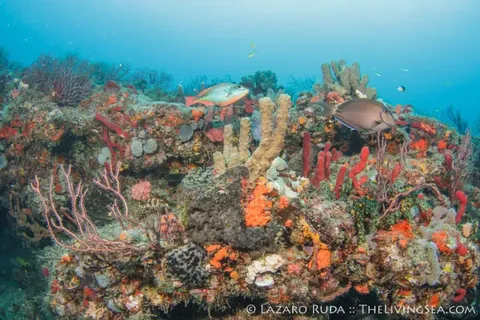
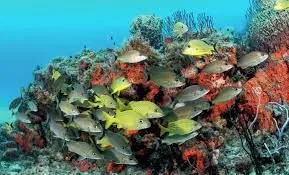
To the south of the trench, the reef habitat generally exhibits lower quality than the northern section. It supports smaller colonies of hard and soft corals, along with numerous barrel sponges (some reaching up to 5 feet or 1.5 meters in size). Cleaning stations are common here, and schools of Bermuda chub, porkfish, and grunts frequently cruise the reef. Immediately north of the trench lies an area called Dive-O-Rama, where lemon sharks are often spotted. This part of the dive site is also a hotspot for small cryptic species like frogfish, flamingo tongues, and cleaner shrimp.
Route & typical conditions
Route
When divers explore the area known as Flower Gardens, they are typically dropped about 1,000 feet (305 meters) to the south of the trench. The prevailing currents flow from south to north along this part of the coast, allowing divers ample time to descend to the reef and drift northward before encountering the trench.
As divers descend, they may notice several telecommunications cables running perpendicular to the reef. The presence of these cables depends on how far south the divers are dropped by their dive operator. These cables serve to supply nearby islands in the Bahamas. The trench itself lies approximately 175 feet (53 meters) after the last of these cables.
The typical dive route involves entering the trench. Divers then swim along its length, avoiding the prevailing current. Once they reach the coral-encrusted boulders and sandbags just beyond the halfway point, they turn back along the trench. From there, they can cross over to the reef situated to the north—an area known as Dive-O-Rama.
Heading northwest after Dive-O-Rama, divers often encounter yellowhead jawfish in the sand and rubble areas along the western edge of the reef. Additionally, they may spot the occasional midnight and blue parrotfish.
Typical conditions
Conditions are usually really good in this site - this makes this site a local favorite for operators in the area. Although currents tend to be 1 knot and above, visibility seldomly disappoints in this site.
Divers' uploaded pictures
No diver pictures yet.