

Lotus
Wreck · Miami Beach
25° 50.957' N 80° 04.647' W
 Technical Hypoxic Trimix Max 235 ft Avg 215 ft Hot Drop
Today AMPoor
Details
Technical Hypoxic Trimix
Minimum recommended certification
- Max depth
- 235 ft
- Average depth
- 215 ft
- Access
- Hot Drop
- Sea state today
- AMPoor PMPoor
Pictures 2
Where it is
25° 50.957' N 80° 04.647' W
Next boats to this site 0
No confirmed trips to this site are listed yet.
Operators that dive here

Best Gas


Gas prices
| Diluent tank | $35.50 |
| O2 tank | $10.00 |


Gas prices
| Aluminum 80 | $10 |
| Steel HP 100 | $10 |
| Steel LP 85 | $10 |
Wreck Details
Sunk February 12th, 1971
Freighter
172 ftLength
32 ftBeam
Site description
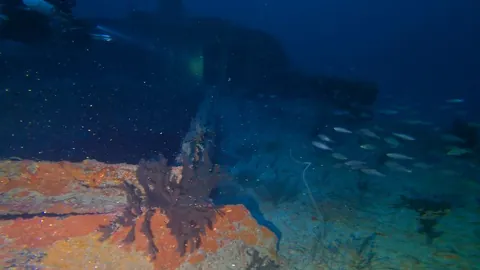
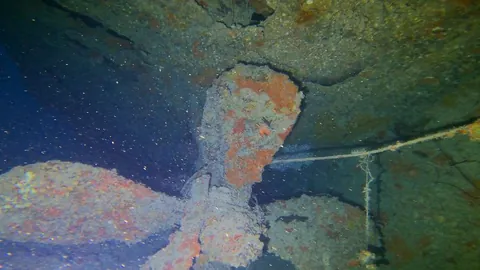
The Lotus is a deep wreck that sits upright and it's mostly intact. One of the very few 50 year old wrecks that still can claim to be on its feet.
Given its time underwater the wreck is completely colonized by corals and invertebrates. Also fishing lines have colonized this wreck as well - divers shall be extra careful when diving the Lotus to avoid entanglement. Most of the superstructure is gone already, but it offers good penetration and swims through..
Route & typical conditions
Route
Given its depth, divers shall do a couple a couple of laps around the wreck to get a feeling for it. Then attempt penetration to the different compartments. Penetration is not difficult in this wreck, but divers shall be on the look for sharp edges.
Typical conditions
This wreck is always very dark at depth but surrounded by beautiful cerulean blue waters. Currents are mostly mild at depth but can be strong at the surface - posing an extra challenge on the hot drop.
Wreck history

The USAMP Col. Albert Todd, built in 1919-20 by the U.S. Army Quartermaster Department at Fabricated Ship Building in Milwaukee, WI, has a rich history. Launched in 1920, it was named in honor of Colonel Albert Todd, a distinguished artilleryman who commanded the Eastern Artillery District from 1910 to 1911.
Initially assigned to the North Pacific Coast Artillery District on May 4, 1920, the vessel was accepted for service by the Quartermaster Corps on September 20, 1920. Commissioned as the USAMP Col. Albert Todd, Captain Edward E. Murphy, USA, took command. Its role was within the U.S. Army Coast Artillery Corps, specifically as part of the Mine Planter Service.
Departing Milwaukee in October 1920, the ship arrived at the Army Supply Base in Brooklyn, New York, in November 1920. It typically docked at Pier #6 in Hoboken, New Jersey. Although further assigned to the Coast Defenses of Puget Sound on November 9, 1920, it never actually served in that location.
In April 1921, the vessel was transferred to Fort Totten, New York, and later, in September 1921, to Fort Wood, New York. However, by October 6, 1924, it was decommissioned at Fort Wood and transferred to the U.S. Lighthouse Service under the Department of Commerce.
Fast forward to July 1, 1939, when the USAMP Col. Albert Todd was absorbed into the U.S. Coast Guard and commissioned as the USCGC Lotus (WAGL-229). The Lotus operated out of Boston until 1941, when it transferred to Chelsea, Massachusetts. During World War II, it played a crucial role by laying buoys and anti-submarine nets to assist convoys rallying at Newfoundland. Later, it conducted standard work in the Caribbean.
After its service with private owners, the Lotus met an unexpected fate. Abandoned on the Miami River, it became one of the derelict vessels targeted for removal. On February 12, 1971, Miami-Dade County loaded the rusting Lotus with explosives and had it blown up at sea approximately two miles offshore.
Name History:
USAMP Col. Albert Todd (1920)
Lotus (1924)
Divers' uploaded pictures
No diver pictures yet.