

Osborne Tire Reef
Other · Fort Lauderdale
26° 08.322' N 80° 04.897' W
 Open Water Max 70 ft Avg 64 ft Hot Drop
Today AMPoor
Details
Open Water
Minimum recommended certification
- Max depth
- 70 ft
- Average depth
- 64 ft
- Access
- Hot Drop
- Sea state today
- AMPoor PMPoor
Video
🎥 4ocean
Pictures 2
Where it is
26° 08.322' N 80° 04.897' W
Next boats to this site 0
No confirmed trips to this site are listed yet.
Best Gas


Gas prices
| Diluent tank | $35.50 |
| O2 tank | $10.00 |
atm
atm


Gas prices
| Aluminum 80 | $10 |
| Steel HP 100 | $10 |
| Steel LP 85 | $10 |
NDL at is
24 hr min surface interval
Always use a dive computer
Site description
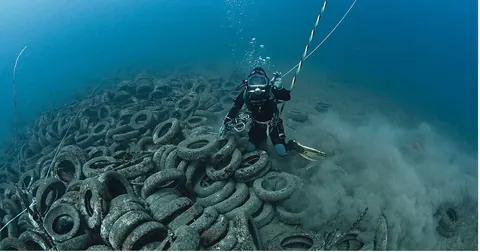
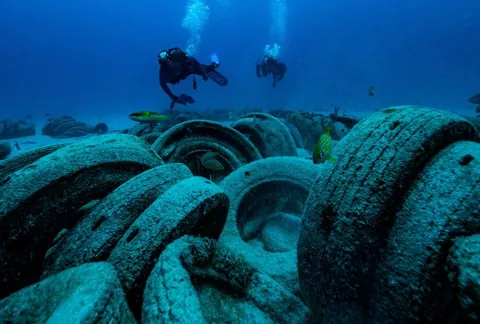
Back in the 1970s, the Osborne Reef was conceived as an innovative solution to repurpose discarded tires. The idea was to create an artificial reef by sinking thousands of tires off the coast of Fort Lauderdale, Florida. These tires were bundled together and placed on the ocean floor, with the hope that they would provide habitat for marine life and enhance recreational diving opportunities.
However, reality didn’t quite match the vision. Over time, several issues emerged:
Environmental Impact: The tires began to break apart, releasing toxic chemicals and pollutants into the water. Far from promoting marine biodiversity, the reef became an ecological hazard.
Scattering and Displacement: Storms, strong currents, and natural forces caused the tires to scatter, disrupting the intended reef structure. Instead of a cohesive habitat, the tires ended up strewn across the ocean floor.
Ineffective Habitat: Contrary to expectations, the tires didn’t attract a diverse range of marine species. Their irregular shape and unstable positioning made them less appealing to fish and other organisms seeking shelter.
Cleanup Efforts: Recognizing the environmental damage, cleanup efforts began. The U.S. military and later civilian organizations worked tirelessly to remove the tires. By 2019, approximately one-third of the tires had been retrieved.
Lessons Learned: The Osborne Reef serves as a cautionary tale for future artificial reef projects. It highlights the importance of thorough planning, understanding local ecosystems, and considering long-term consequences.
Today, the remnants of the Osborne Reef continue to remind us of the delicate balance between human intervention and nature’s resilience. While the initial intentions were noble, the execution fell short, emphasizing the need for sustainable and well-researched approaches to marine conservation.
UPDATE Jul-2024: divers have reported that very few and scattered tires remain on the sand.
Route & typical conditions
Route
This is conducted as a drift dive. Divers may see a couple of barges after the tires and past behind.
Typical conditions
Conditions are generally good. For this kind of dive a mild current is perfect to help divers cover this large area (north current are the norm).
Visibility is usually good, ranging from 30 to 70 feet.
Divers' uploaded pictures
No diver pictures yet.