

Queen of Nassau
Wreck · Islamorada
24° 47.165' N 80° 39.546' W
 Technical Hypoxic Trimix Max 230 ft Avg 210 ft Hot Drop
Today AMNo dive
Details
Technical Hypoxic Trimix
Minimum recommended certification
- Max depth
- 230 ft
- Average depth
- 210 ft
- Access
- Hot Drop
- Sea state today
- AMNo dive PMNo dive
Video
🎥 Didier Follain-Grisell
Where it is
24° 47.165' N 80° 39.546' W
Next boats to this site 0
No confirmed trips to this site are listed yet.
Operators that dive here
Best Gas

Gas prices
| Diluent tank | $35.50 |
| O2 tank | $10.00 |

Gas prices
| Aluminum 80 | $10 |
| Steel HP 100 | $10 |
| Steel LP 85 | $10 |
Wreck Details
Sunk July 2, 1926
Steamer
200 ftLength
25 ftBeam
Site description
In 1904, the Canadian Government Ship (CGS) Canada emerged from the shipyards of Vickers Sons and Maxim Ltd. in Barrow-in-Furness, England, marking a significant milestone as Canada's inaugural armed, steel-hulled cruiser. Commissioned by the Canadian government, the 200-foot-long steamship was christened CGS Canada and entrusted to the Canadian Fisheries Protection Service.
This vessel represented a pivotal advancement for Canada, symbolizing its growing maritime capabilities and commitment to safeguarding its fisheries. For almost 15 years, CGS Canada diligently patrolled Canadian waters, ensuring the protection of vital marine resources.
In 1920, after faithfully serving its nation, the CGS Canada was decommissioned, concluding a chapter of pioneering naval history that laid the foundation for Canada's future fleet operations.
Route & typical conditions
Route
The shipwreck itself, despite its collapsed mast and some damage to the stern and running gear, remains largely intact. However, the wood decks have eroded over time, causing any artifacts once situated there to now lie deeper below the surface.
Accessing the lower parts of the wreck is hindered by a thick layer of fine sediment that has accumulated over the years. This sediment can easily stir up and reduce visibility, so divers must exercise caution while navigating these sections.
Despite these challenges, divers will be rewarded with encounters with a variety of marine life. The area is known for its large fish population, including snapper, grouper, amberjack, and sharks. In recent years, lionfish have also made their home around the wreckage, adding to the site's biodiversity.
Typical conditions
Diving in this area presents unique challenges due to the cold water temperatures, which require divers to wear a dry suit or heavy wetsuit along with thicker gloves and a hood for comfort and safety. Additionally, strong currents are common, adding to the complexity of the dive.
Wreck history
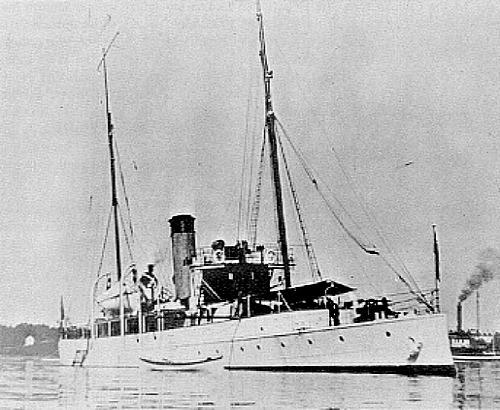
The Canadian Government Ship (CGS) Canada, commissioned in 1904 by Vickers Sons and Maxim Ltd. in Barrow-in-Furness, England, represented a pioneering step in Canada's naval capabilities. Built as a unique cruiser for the Canadian Fisheries Protection Service, the 200-foot-long vessel was armed with four high-powered Maxim guns, emphasizing its dual role in protecting Canada's fishing interests and serving as a training platform for the Royal Canadian Navy (RCN).
Powered by two large triple expansion engines, CGS Canada boasted a top speed of 22 knots, making it the fastest ship in the Fisheries Protection fleet stationed out of Halifax, Nova Scotia. In 1915, amid World War I, CGS Canada was commissioned into the RCN as HMCS Canada, reflecting its upgraded armaments to include two 12-pound and two 3-pound cannons. During its RCN service, HMCS Canada conducted mine surveys and escorted troop convoys to England.
Following its wartime duties, HMCS Canada reverted to the Canadian Fisheries Protection Service after the war's end, continuing its vital role in safeguarding Canada's east coast fishing grounds until its decommissioning in 1920.
Subsequently sold in 1924 to Barron Gift Collier's Florida Inter-Island Steamship Company and renamed Queen of Nassau, the vessel transitioned to a commercial role, albeit with challenges due to its original design as a man-of-war rather than a luxury cruise ship. Tragically, en route from Miami to Tampa in 1926, the ship experienced catastrophic flooding and subsequent boiler explosions, sinking off Islamorada, Florida.
Rediscovered in 2001 by divers from the Association of Underwater Explorers, the wreck of Queen of Nassau lay intact at a depth of 230 feet, seven miles from Lower Matacumbe Key. The discovery prompted further investigation by NOAA archaeologists, who confirmed the vessel's identity through its distinctive features such as its ram bow and riveted steel construction.
Ongoing archaeological research led by NOAA's Maritime Heritage Program, in collaboration with East Carolina University and the National Undersea Research Center at the University of North Carolina-Wilmington, continues to uncover the historical significance of the site, shedding light on the dual maritime roles of CGS Canada and Queen of Nassau throughout their operational histories.
Divers' uploaded pictures
No diver pictures yet.