Twin Ledges
Reef · Fort Lauderdale
26° 07.601' N 80° 05.678' W
 Open Water Max 20 ft Avg 15 ft Hot Drop
Today AMPoor
Details
Open Water
Minimum recommended certification
- Max depth
- 20 ft
- Average depth
- 15 ft
- Access
- Hot Drop
- Sea state today
- AMPoor PMPoor
Pictures 1
Where it is
26° 07.601' N 80° 05.678' W
Next boats to this site 0
No confirmed trips to this site are listed yet.
Operators that dive here


Best Gas


Gas prices
| Diluent tank | $35.50 |
| O2 tank | $10.00 |
atm
atm


Gas prices
| Aluminum 80 | $10 |
| Steel HP 100 | $10 |
| Steel LP 85 | $10 |
NDL at is
24 hr min surface interval
Always use a dive computer
Site description
Twin Ledges lies just inside the inner reef tract, which runs parallel to the shore. This reef tract is marked by two buoy lines: one to the north (Oakland Ridges) and one to the south (The Caves/Twin Ledges). The Twin Ledges site, described in this chapter, is situated between these two buoy lines and slightly closer to the shore.
At this site, there is no permanent mooring buoy. Dive and snorkel tour operators typically drop anchor in the sand to the east of the reef, positioning the boat over the central sand channel. Visibility varies but is generally sufficient for a clear view of the reef from the surface. Currents are usually mild.
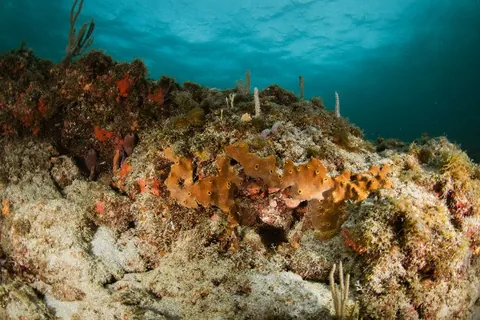
The natural reef itself varies in depth from 10 to 20 feet (3 to 6 meters). Comprising a long, relatively narrow stretch of limestone blocks, the reef features undercut areas. The most intriguing part for divers—and snorkelers skilled at breath-holding and duck diving—is a sand channel that runs approximately 17 feet (5 meters) wide through the blocks, extending from north to south for about 80 feet (25 meters).
Smaller channels branch off from the main sand channel, cutting through the blocks and leading to the sandy seabed on the eastern side. Toward the southwest and northwest, the reef flattens out and is adorned with sea fans and other soft corals. Directly westward, as you approach the shore, the reef transitions into sandy terrain.
Divers and snorkelers exploring Twin Ledges are likely to encounter a diverse array of fish and crustaceans. Bermuda chub, Atlantic spadefish, bar jacks, and sergeant majors often surround snorkelers near the surface. Meanwhile, balloonfish, angelfish, parrotfish, grunts, goatfish, trumpetfish, and occasional scorpionfish inhabit the reef or the sand channel. Beneath the limestone blocks, nurse sharks, lobsters, glassy sweepers, and grouper find shelter.
Route & typical conditions
Route
Novice snorkelers often delight in observing the abundant chub and sergeant majors near the surface. In contrast, experienced snorkelers and divers typically trace the sand channel from north to south, venturing into the reef’s undercut areas where lobsters and grouper reside.
Typical conditions
Conditions are typically good. Visibility ranges from 30 to 60 feet and currents are often non-existent.
Divers' uploaded pictures
No diver pictures yet.