Wilkes-Barre
Wreck · Key West also known as wilkes
24° 29.094' N 81° 33.202' W
 Technical Hypoxic Trimix Max 240 ft Avg 210 ft Hot Drop
Today AMPoor
Details
Technical Hypoxic Trimix
Minimum recommended certification
- Max depth
- 240 ft
- Average depth
- 210 ft
- Access
- Hot Drop
- Sea state today
- AMPoor PMPoor
Video
🎥 ISDC
Pictures 2
Where it is
24° 29.094' N 81° 33.202' W
Next boats to this site 0
No confirmed trips to this site are listed yet.
Best Gas


Gas prices
| Diluent tank | $35.50 |
| O2 tank | $10.00 |


Gas prices
| Aluminum 80 | $10 |
| Steel HP 100 | $10 |
| Steel LP 85 | $10 |
Wreck Details
Sunk May 12th, 1972
Cruiser
610 ftLength
66 ftBeam
Site description
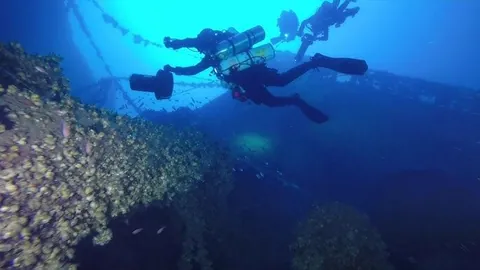
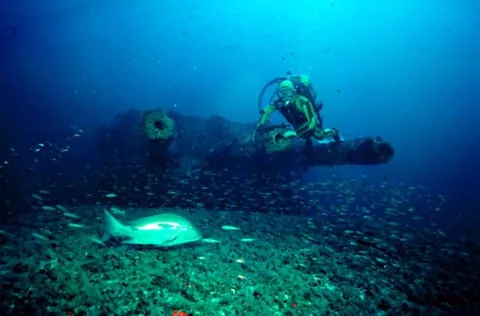
The USS Wilkes-Barre, often referred to as the “Willie Bee,” is a renowned dive site located off Cudjoe Key, about 13.5 miles southwest of Summerland Key in the Florida Keys. This site is particularly popular among technical divers due to its depth and the challenges it presents. The Wilkes-Barre is a Cleveland-class light cruiser that was commissioned during the final year of World War II. The ship now rests in approximately 240 feet of water, making it one of the deeper wreck dives in the region.
The wreck is known for its impressive size and structure. At 608 feet long, the Wilkes-Barre offers a substantial underwater landscape for exploration. The ship is split into two main sections, with the bow and stern lying separately on the ocean floor. This separation provides divers with a unique opportunity to explore different parts of the wreck, each with its own distinct features and marine life. The top of the smokestack rises to about 180 feet, offering a shallower point of interest for divers.
Marine life around the Wilkes-Barre is abundant and diverse. The wreck attracts a variety of fish species, including large schools of jacks, snappers, and groupers. The structure of the ship provides numerous hiding spots for smaller creatures such as lobsters, crabs, and moray eels. Divers may also encounter larger pelagic species like barracudas and sharks, which are often seen patrolling the wreck. The presence of these predators adds an element of excitement and unpredictability to the dive.
Due to its depth, diving the Wilkes-Barre requires advanced technical diving skills and equipment. Strong currents and the need for decompression stops make this site suitable only for experienced divers with proper training1. Despite these challenges, the Wilkes-Barre remains a sought-after destination for those looking to experience one of the most remarkable deep wreck dives in the Florida Keys.
Route & typical conditions
Route
This is a really challenging dive - for both divers and boat crews. For starters hitting the wreck is a mission on its own.
The wreck is split in two and each one deserves a full dive. The most interesting section is the stern that presents most of the penetration opportunities.
The top of the superstructure can fe found at around 150 feet below water, but most of the dive will happen at around 200 feet.
Bow: 24º 29.094' N, 81º 33.202'W
Stern: 24º 29.069' N, 81º 33.138'W
Typical conditions
Conditions are typically as challenging as they can be: divers should expect moderate to strong current, reduced visibility and a dark environment. Also, large marine life is another condiment added to the equation - divers have even reported seeing sperm whales in this site.
Wreck history

The U.S.S. Wilkes Barre, CL-103, was a Cleveland-class light cruiser built and launched by the New York Shipbuilding Corp on December 24, 1943. Her armament consisted of twelve 6-inch guns, twelve 5-inch guns, and a battery of 40 and 20-mm anti-aircraft guns. She was commissioned at the Philadelphia Navy Yard on July 1, 1944, with Captain Robert L. Porter, Jr., in command, and saw significant action during World War II.
On February 16, 1945, the Wilkes Barre screened aircraft carriers as their planes bombed Tokyo. Just a few days later, on February 21, 1945, she was called in to assist in the shore bombardment of Iwo Jima. On March 19, 1945, while steaming east of Okinawa, the gunners on the Wilkes Barre shot down her first enemy aircraft, a Judy dive bomber. On April 1, 1945, she supported the largest American amphibious assault in history, the invasion of Okinawa.
After the war, on January 13, 1946, the Wilkes Barre sailed back to the United States. She had received four battle stars for her World War II service and had shot down seven enemy aircraft. The ship was decommissioned and placed in Philadelphia on October 9, 1947. On May 12, 1972, the Wilkes Barre was used as the subject for underwater explosive tests, which broke the ship in two. Her stern sank quickly, but her forward section required an additional scuttling charge to send it to the ocean’s floor.
Divers' uploaded pictures
No diver pictures yet.