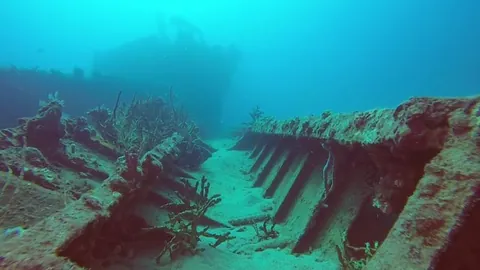
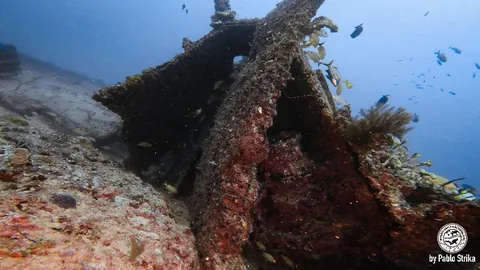
Undoubtedly, the one vessel with the most notorious history sunk in the Florida artificial reef program is that of the United Caribbean. The United Caribbean was a 150‐foot long freighter sunk August 22, 2000, off Boca Raton in approximately 70 feet of water. This freighter originally made news in 1993 as the Golden Venture. In early 1992, Lee Peng Fei and Cheng Chui Ping coordinated a smuggling operation for Chinese nationals wishing to enter the United States. The cost for each would‐be immigrant w a s between $15,000 and $30,000. The original plan called for the Chinese passengers to travel on a ship called the Nudj II from Thailand to the United States, but that ship was forced to moor off the coast of Kenya while its 300 passengers were stranded on board with inadequate food and supplies for five months. Mr. Lee then orchestrated the purchase and refitting of a second ship (which was owned by a New York Chinese organized crime ring), the Panamanian-flagged Golden Venture, which arrived from Singapore to pick up the stranded passengers off the coast of Kenya.
Though the Golden Venture was a cargo ship not licensed to carry passengers, it was already carrying between 90 and 100 Chinese nationals when it arrived in Africa, whereupon approximately 200 of the Nadj II ’s passengers joined them to continue their voyage to the United States on the Golden Venture. Once aboard, the passengers were confined to a 20 by 40 foot cargo hold that had only one ladder leading to the deck. The hold was split into two levels by rows of wooden boards stretching from one side of the ship to the other. Water and food were severely rationed, and there was no water for personal hygiene. The ship had only one toilet, the use of which was restricted to the crew, the smugglers, and the few women passengers on board. It had no life preservers and only two lifeboats, which in turn were adequate to carry only the (unusually small) crew of 14. Passengers who questioned the arrangements were beaten.
The 298 passengers spent between three and six months (depending whether they had boarded in Asia or in Kenya) on the ship as it made its way to the United States. Lee, who was then in New York, had hoped initially that he could arrange for small boats to rendezvous with the Golden Venture in the Atlantic to pick up the passengers and transport them to shore. When this plan fell through, he instructed the Golden Venture to approach the New York harbor. Mr. Lee Peng Fei ordered Kin Sin Lee (whom he had hired to travel on the Golden Venture and oversee its day‐to‐day operations) via ship‐to‐ shore radio to ground the ship at full speed in the dead of night off the coast of Rockaway Point in Queens. Mr. Lee also told Kin Sin Lee to tell the passengers that those who could swim should jump off the ship and swim ashore when the boat was grounded, while the others should wait for someone to pick the mup. No other arrangements were made for disembarking the passengers. Beginning about midnight on June 6, 1993, the crew began its efforts to ground the ship. After twice beginning to speed for the shore and then realizing that the location w a s unsuitable, the ship finally picked a spot on the ocean side of Rockaway Point, and at about 3:00 a.m. r a n the ship aground. The passengers’ only warning that the ship w a s being grounded had been given some 12 hours earlier, when they were told to brace themselves. Chaos ensued. Some passengers jumped into the rough water, which was below 60° F, and 10 of them drowned or died of hypothermia. Survivors were arrested and detained by the Immigration and Naturalization Service as they applied for asylum. The abrupt and tragic ending of the Chinese immigrants’ four‐month journey set off an unprecedented crack down on illegal immigration in the United States. Of the surviving passengers aboard the Golden Venture apprehended by authorities, 155 were ordered deported. At least 99 of those have returned to China, and others have been sent to Latin America; fewer than 40 people have been granted asylum, with a couple others receiving artist’s visas that allow them to remain permanently in the USA. Many others spent several years in jail awaiting a decision on their future. In February 1997, President Clinton released the last 53 Golden Venture detainees, though ultimately only two of these immigrants were allowed to remain in the United States.
The freighter changed hands and names, eventually becoming the United Caribbean only to wind up as a rusting hulk on the Miami River after failing to make a profitable venture running goods between Florida and Haiti. The vessel was eventually abandoned by the owner and subsequently purchased for use as an artificial reef. The United Caribbean is in close proximity to the barge Sea Emperor, and there is a trail of large quarried rock between the 2 sites.
 Open Water