
Nitrox vs. Air: Which Should You Choose for Your Next Dive?
Every dive shop with a fill station offers air. Fewer offer nitrox, and the ones that do usually charge extra for it. Neither fact is an accident - they come from real, physical differences between the two, and knowing them is more useful than a blanket "nitrox is better" answer.
Where nitrox actually earns its keep
Nitrox - enriched air, typically blended to 32% or 36% oxygen against air's 21% - reduces the nitrogen you absorb for a given depth and time, which extends your no-decompression limit. That extension matters most on deeper, longer dives: a multi-tank charter day on a wreck sitting past 80 or 90 feet is exactly where nitrox pays for itself, letting you stay down longer or do another dive sooner without pushing into decompression obligations. On a shallow, short reef dive, air's nitrogen limits were never the constraint in the first place, so nitrox buys you very little.
The certification is classroom only
Getting certified to dive nitrox doesn't require getting in the water. Every major agency's enriched air course is knowledge-based - a few hours of classroom or e-learning covering oxygen exposure limits, how to analyze a tank's actual blend before diving it, and how to calculate a maximum operating depth for whatever percentage you're breathing. There's no in-water skills session because there's nothing physically different about breathing nitrox underwater; the entire course is about understanding the numbers before you go.
The real risk is oxygen, not nitrogen
This is the part worth actually understanding rather than skimming past: nitrox trades a nitrogen problem for an oxygen one. Breathing a higher-than-normal percentage of oxygen at depth raises your risk of oxygen toxicity, which gets more dangerous the deeper and richer the mix - the same 32% blend that's perfectly safe at 60 feet can become genuinely risky well past 100. Every nitrox blend has a real maximum operating depth, and diving it deeper than that is a real hazard, not a theoretical one.
Air doesn't have this problem within recreational limits. Its 21% oxygen content keeps oxygen partial pressure below the toxicity threshold at any depth a recreational diver has any business being at - air is, from a pure oxygen-toxicity standpoint, always safe for recreational diving. That's a real advantage nitrox doesn't have, and it's the reason "just use nitrox on every dive" isn't actually the right advice: on a shallow dive, you're taking on oxygen risk for a nitrogen benefit you don't need.
Air is still the default everywhere
Walk into a dive shop anywhere in the world and air is what's on the fill station. It's the global default for a reason: every compressor that fills a scuba tank can fill it with air, and it costs next to nothing to produce. Nitrox is the exception you have to ask for and usually pay more for, not the other way around - which matters if you're planning a trip somewhere remote, where a shop advertising nitrox at all is worth confirming in advance rather than assuming.
Why not every shop has it
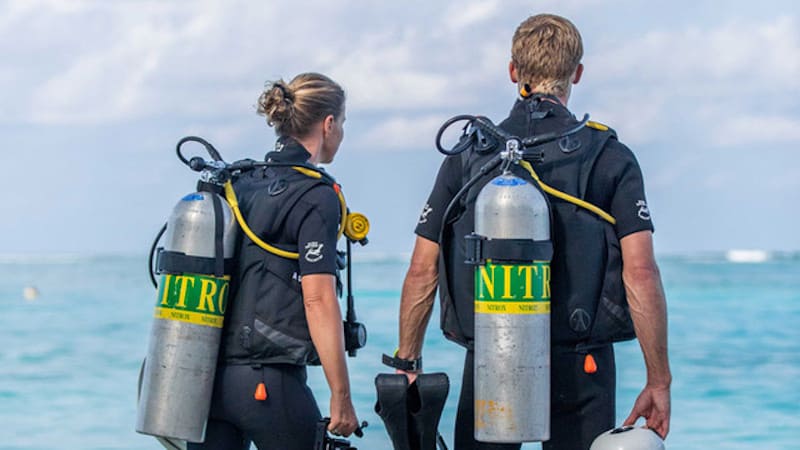
A plain air compressor can't make nitrox on its own. Blending it means either adding pure, medical- or aviation-grade oxygen to a tank before topping it off with air (partial-pressure blending) or running a membrane or continuous-blending system that mixes the two in-line - either way, the shop needs a real source of pure O2, extra tanks and fittings rated for oxygen service, and an analyzer to verify and label every single fill's actual percentage before it goes out the door. That's real equipment and real handling procedures beyond what a basic fill station needs, which is exactly why nitrox costs more and why plenty of shops, especially smaller or more remote ones, simply don't offer it.
So which should you choose
If the dive is deep or you're stacking multiple tanks in a day, ask for nitrox and get certified if you haven't - the extended bottom time is real and worth the extra cost. If the dive is shallow and short, air does the job with nothing extra to think about, and it's what you'll find as the default almost everywhere you travel. Either way, know your blend's maximum operating depth before you get in the water - that's the one number nitrox actually requires you to check that air never does.