
Open Circuit vs. Closed Circuit: Which Is Right for Your Diving?
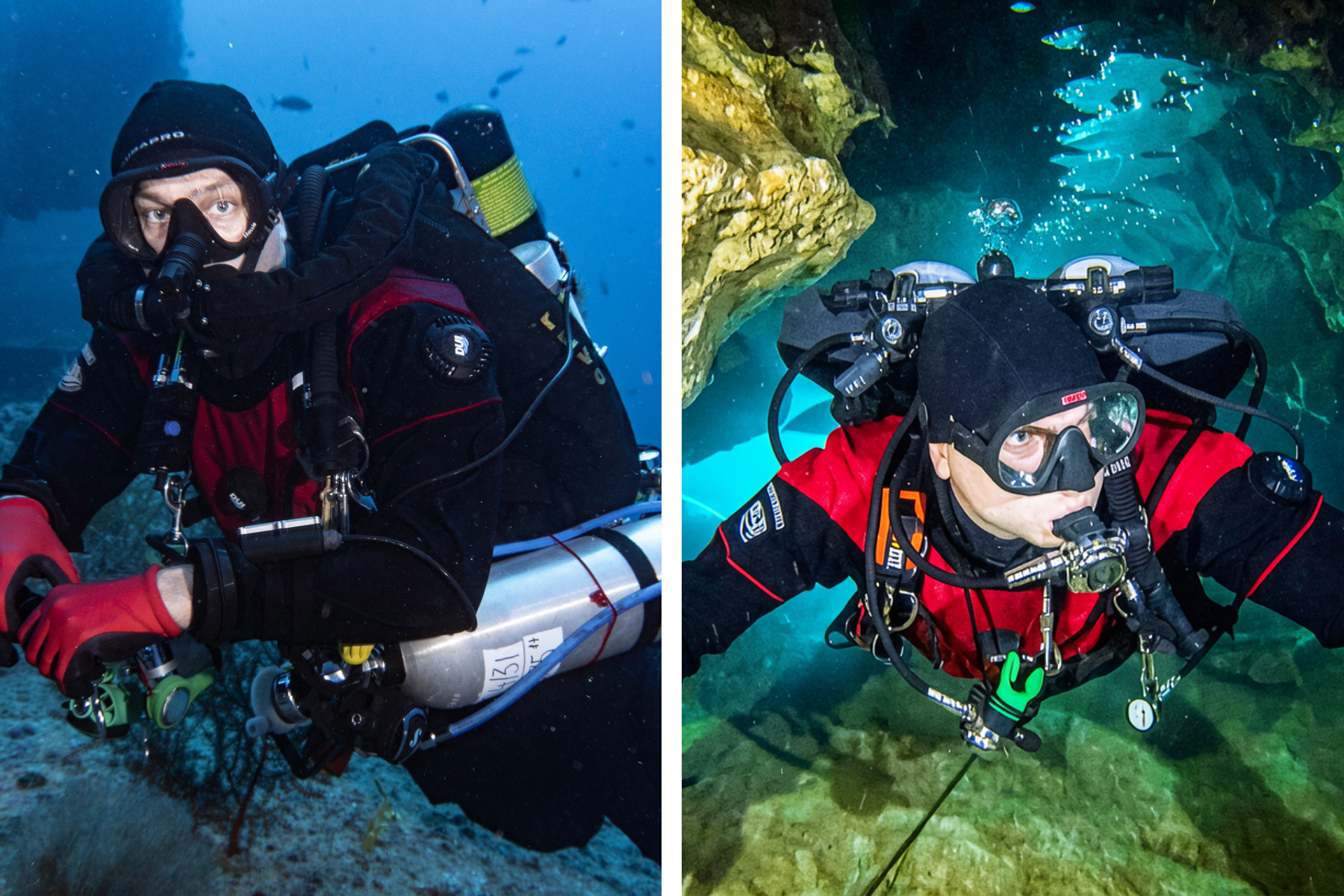
I dive both systems, but closed circuit is where I spend most of my time - open circuit is what I switch to when a specific dive calls for it, not the other way around. Caves in sidemount, or travel when I don't want the hassle of bringing a rebreather along, are exactly when I go back to a tank and a regulator. People ask me fairly often which one is "better," and the honest answer is that they're not really answering the same question. Here's what actually separates them, from someone who switches between the two regularly rather than just reading about it.
Open circuit: simple, direct, and what I reach for by choice
On open circuit, every breath follows the same simple path: you inhale gas from the tank, exhale it, and that gas vents straight into the water as bubbles. It's a direct, rugged, extremely reliable system, and it's exactly what I want in two specific situations: caves, where I dive it sidemounted, and travel, when I don't want to bring a rebreather and its support gear along for the trip. My computer calculates decompression against the one fixed gas mix I'm carrying, and how long that gas lasts comes down entirely to how I breathe - the deeper I go, the faster the tank empties. It's also the right system for learning to dive, for reef diving, and for most of the diving anyone will ever do.
Closed circuit: the rebreather, and where I actually spend most of my time
A rebreather works on a completely different principle, and the first time you dive one it genuinely feels like a different sport. Instead of venting your exhaled gas, it recycles it. When you breathe out, that gas passes through a scrubber that removes carbon dioxide, and the unit then adds back exactly the oxygen you need to stay at a safe level. What you get is a constant, optimized breathing mix with almost no bubbles, minimal gas consumption, and bottom times that can run two or three times longer than the same dive on open circuit. That's why it's become my default rather than my exception - more time at depth, on a better gas mix, with a lot less gear to haul around once it's set up.
The real difference: who controls the gas
The most important distinction between the two systems is gas control. On open circuit, the mix is fixed - if I'm carrying air, I'm breathing air; if I'm carrying nitrox, I'm breathing nitrox, for the whole dive. On a rebreather, the mix is constantly changing. The unit adjusts oxygen continuously to hold a stable partial pressure, which makes decompression more efficient and lets me spend more time at depth with a smaller nitrogen load. That's what makes it such a genuinely powerful tool for photography, filming, and deep diving specifically - not a novelty, a real capability difference.
What that efficiency costs you
None of that comes free, and I don't say this lightly: a rebreather demands specialized training, constant pre-dive checks, and real discipline every single time. The unit is more complex, more sensitive, and it requires you to genuinely understand every component - not improvise, not skip a step, not assume it's fine because it was fine yesterday. Open circuit, by contrast, is simple, direct, and forgiving of mistakes in a way closed circuit just isn't. That's exactly why open circuit remains the standard for the vast majority of recreational divers, and why it's still my own choice the moment a dive plan calls for sidemount in a cave or a lighter travel kit.
A completely different dive
The two systems don't just differ mechanically - they feel different, and this is the part that surprised me most switching between them. On open circuit, the bubbles are part of the dive itself: the sound, the rhythm, the sensation of every exhale. On a rebreather, there's near total silence. No bubbles, no noise, no vibration. Going back to open circuit after a stretch of diving CCR is its own adjustment - your buoyancy, your pacing, even how you read the reef or the cave wall around you shift depending on which one you're on. That silence on the rebreather is also exactly why I find it so effective for getting close to marine life without spooking it, and for filming something clean and stable instead of a frame full of my own bubbles.
Two tools, not two competitors
Closed circuit is my default: quiet, efficient, and built for dives where I want more bottom time, more depth, or more control over my gas. Open circuit is the tool I switch to deliberately - sidemounted in caves, or whenever I'm traveling light and don't want to bring a rebreather along. They aren't competing for the same job. Open circuit is the foundation everything else in diving builds on, including CCR itself - every rebreather diver learned open circuit first. Closed circuit is a door into a more technical, more specialized side of the sport, and I'd never suggest skipping straight to it.
The question was never which system is better - it's which one actually fits the dive you're planning. Both share the same underlying philosophy: exploring the underwater world with respect, real preparation, and real safety margins. I still get something different out of each one, and honestly, that's the whole appeal of having both in the bag.