
The 300-Foot Rule: Florida's Dive Flag Law and Why It Cuts Both Ways
A flag is a contract between people who cannot see each other
One of you is forty feet down with a camera. The other is doing twenty-five knots with the sun in his eyes. The flag is the only thing passing between you.
Most Florida divers know they need one. Far fewer know the law puts obligations on them too, or that flying a flag when nobody is in the water is itself illegal. Both halves matter, because a signal only works when everyone reads it the same way.
What counts as a flag
Florida law is specific, and the specifics are the point.
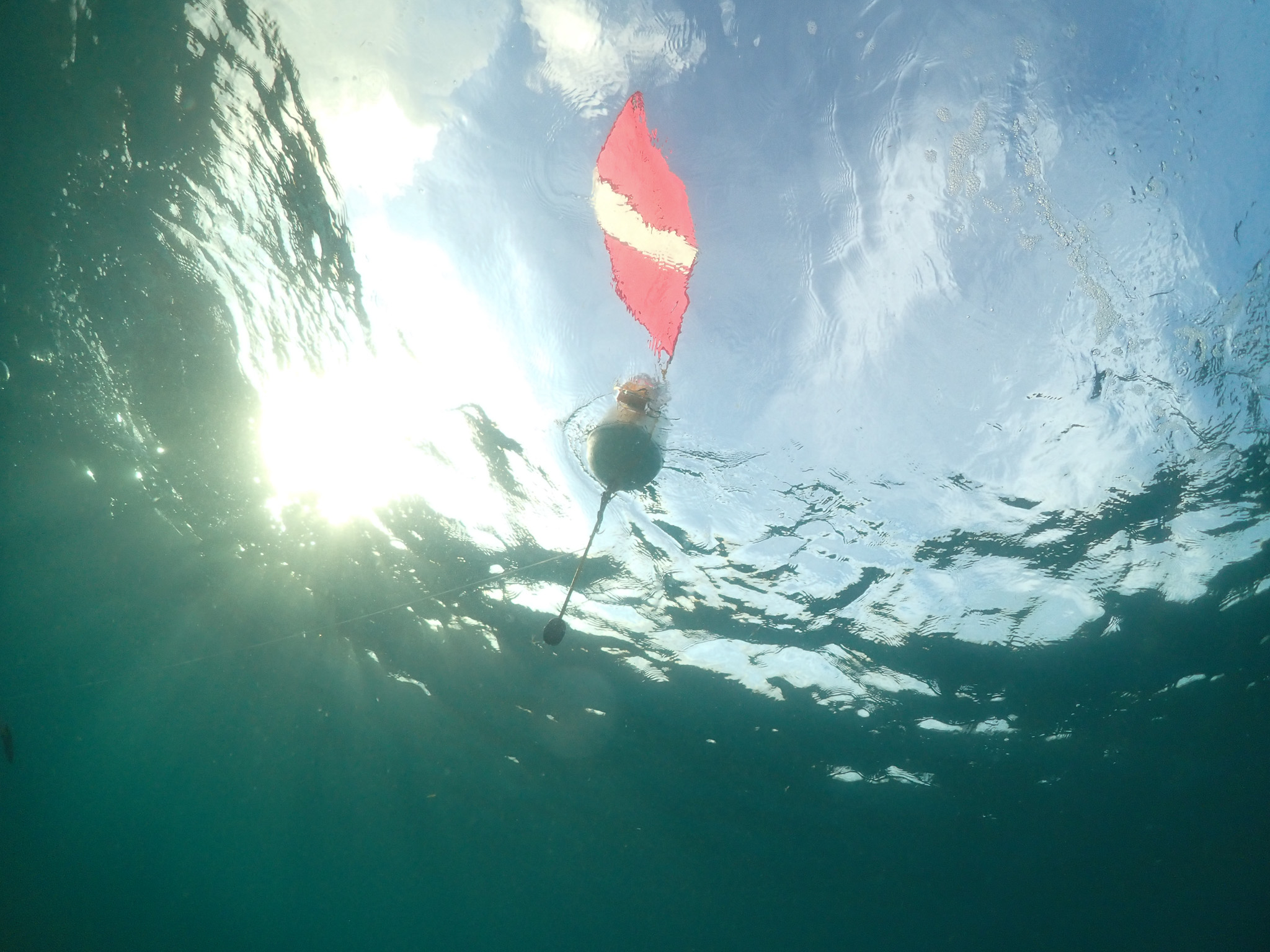
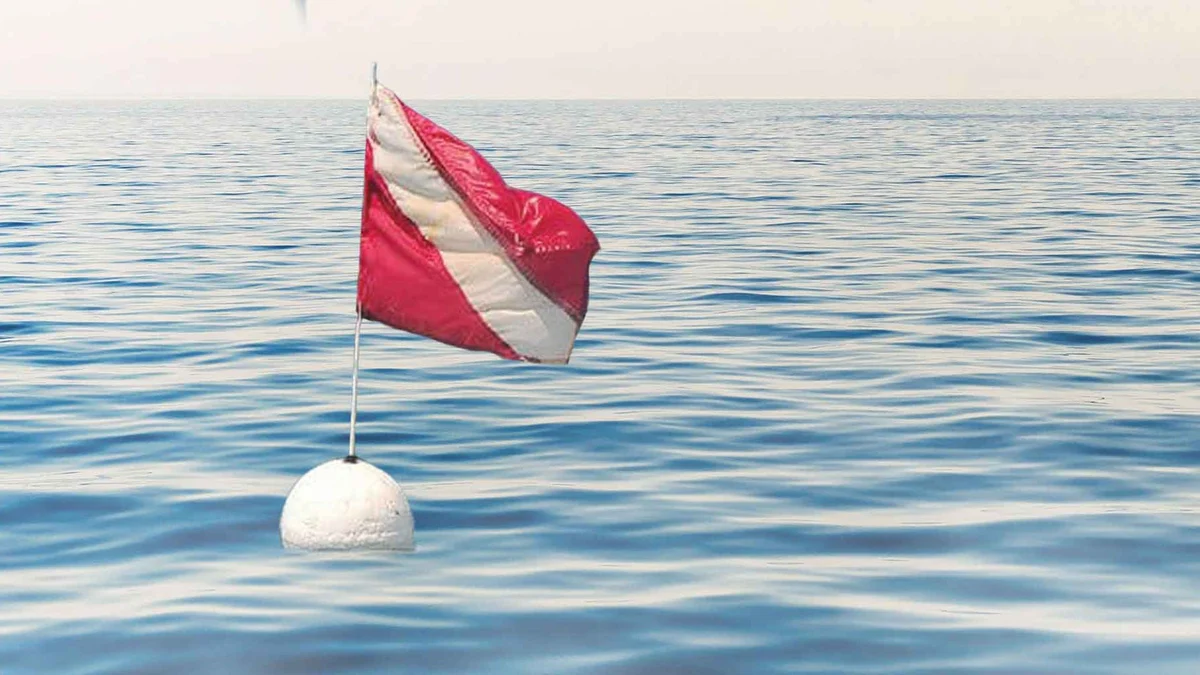
The divers-down symbol is a red rectangle or square with a white diagonal stripe. Displayed from a vessel it must be at least 20 by 24 inches, flown from the highest point where it is visible all the way around. Displayed from the water, on a float or a buoy, the minimum is 12 by 12 inches, and a buoy has to carry the symbol on every flat side.
There is one more requirement people skip: the flag must have a wire or other stiffener, or otherwise be built to stay fully unfurled. On a windless August afternoon, a limp flag hanging down its own staff is a red rag. It is not a signal. The stiffener is what makes it legible at distance, which is the only distance that counts.
Up when you are down, down when you are up
The flag goes up when divers are in the water and comes down the moment the last one is aboard or ashore. A vessel may not display a divers-down device unless it actually has divers in the water.
This is the rule divers break most often, and it does real damage. Every boat that motors around all day with the flag still flying teaches the boaters who see it that flags do not mean anything. The next flag they pass might have your head under it.
The requirement applies any time someone is wholly or partially submerged using a mask and snorkel or scuba, which includes snorkelers, the group most likely to assume none of this applies to them.
Your half of the deal
Here is the part that surprises people. The law asks divers to make reasonable efforts to stay within 300 feet of the flag in open water, and within 100 feet in rivers, inlets and navigation channels.
That is an obligation on you, not just on the boats. The logic is simple: the flag marks a protected circle, and outside that circle you are a swimmer in open water that no boat has any reason to expect. Surfacing four hundred feet downcurrent of your float does not just void the protection. It puts you exactly where nobody is looking.
The shorter 100-foot distance applies in tighter water. If you are diving somewhere like the Blue Heron Bridge, with a marked channel nearby and traffic moving through it, that is the number that governs, and the margin for error is much thinner.
The boater's half
Vessels must stay at least 300 feet away from a divers-down device in open water, and at least 100 feet in rivers, inlets and navigation channels. Inside those distances, a boat must proceed no faster than necessary to maintain headway and steerage.
Read that last part again, because it is not "slow down." It is idle, the minimum speed that still lets you steer. Anything above that, within 300 feet of a flag, is a violation.
Violating these provisions is a noncriminal infraction under Florida's boating penalty statute. The citation is the least of it. The FWC responds to incidents every year where a diver was struck, injured or killed by a vessel.
Why 300 feet
Three hundred feet sounds excessive until you convert it to time.
A boat at 25 knots covers about 42 feet every second. Three hundred feet of warning is roughly seven seconds. Seven seconds for a captain to spot a flag, recognize what it is, understand that there are people underneath it, and pull back the throttle. That is not a generous cushion. That is the minimum a human being needs.
And if you want a reference for judging the distance on the water: a football field, goal line to goal line, is exactly 300 feet. When a flag looks a football field away, you are at the edge of legal, not comfortably clear of it.
Drift diving changes the picture
Most of our best diving in Palm Beach and Jupiter is live-boat drift diving, and that works differently from anything a visiting diver learned on a mooring ball in the Keys.
There is no anchor. The divers go in, the current takes them, and the boat follows the bubbles with the flag flying the whole way. The protected circle moves with the group.
If you are a boater who sees a dive flag tracking steadily north at a knot and a half, that is not a boat that forgot to take its flag down. That is a dive boat marking people below it, and the 300 feet applies to where that flag is right now, not where it was when you first noticed it.
If you are the diver, this is the argument for staying with your group and your divemaster's float. The circle only protects the people inside it.
How live-boat drift diving actually works
One flag, not two
You will occasionally see the blue-and-white Alpha flag on a boat. That is an international signal indicating a vessel restricted in its ability to maneuver, and some operators fly both.
In Florida waters, the red flag with the white diagonal stripe is the one written into state law. If you are carrying one flag, carry that one.
The flag is not armor
Everything above is the legal minimum, and the legal minimum has never stopped a propeller.
Treat the flag as the first layer, then add the ones that are actually under your control.
Listen on the way up. Engine noise carries, and it carries best in the last twenty feet, where it matters most.
Ascend on the line or under the boat when you can, rather than popping up wherever your computer lets you.
Carry a surface marker and deploy it before you leave the bottom, so the boat has something tall and orange to see instead of a head in a chop.
At the surface, look around once before you take your eyes off the horizon to sort out your gear.
The flag tells the world where you are. Everything else is on you and your buddy.
Full text of the law: Florida Statute 327.331, divers-down warning devices.
Read the statute
FWC guidance for boaters and divers
Dive these sites
-
1
Blue Heron Bridge
A good example of a shallow protected site. Yet carrying a dive flag is paramount.

 OW
OW