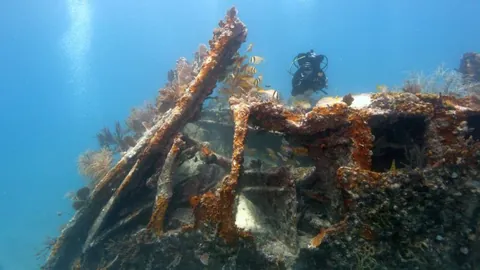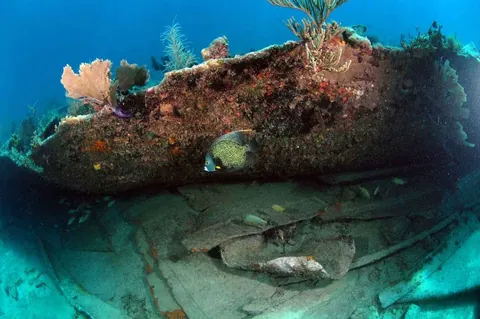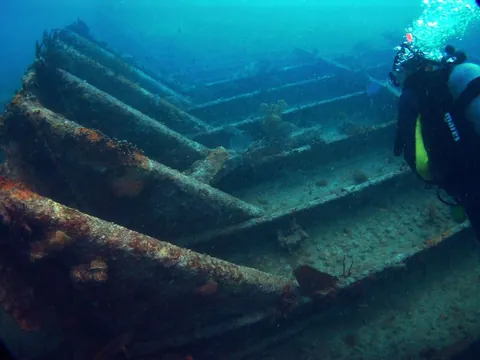

The SS Benwood, a steam cargo ship from the early twentieth century, was constructed by Craig, Taylor & Co. Ltd. in Stockton on Tees. Initially in service with Joseph Hoult & Co. Ltd. in Liverpool, the Benwood changed hands multiple times before meeting its fate in a collision off the coast of Key Largo, Florida, in 1942. Today, its wreck is a popular destination for divers.
On the night of April 9, 1942, the Norwegian merchant freighter Benwood (measuring 360 feet in length and 51 feet in width) was under the command of Captain Torbjørn Skjelbred. The ship was on a routine voyage from Tampa Bay, Florida, to Norfolk, Virginia, carrying a load of phosphate rock. Simultaneously, the Robert C. Tuttle (544 feet long and 70 feet wide) was en route to Atreco, Texas, under Captain Martin Johansen’s command. Due to the threat of German U-boats in the area, both vessels operated under complete blackout conditions, maintaining specific distances from the Florida coastal lights (three miles abeam for the Benwood and one and a half miles abeam for the Robert C. Tuttle).
Around 12:45 a.m., the Robert C. Tuttle spotted a black object ahead and signaled its intention to turn starboard. However, there was no response from the other ship. At 12:50 a.m., the Benwood also sighted a black object to starboard and signaled its intention to turn port, yet received no acknowledgment. Unbeknownst to both crews, the ships were on a collision course. Just before impact, Captain Skjelbred ordered the engine full astern in a last-ditch effort to avoid the Robert C. Tuttle. Nonetheless, the Benwood’s bow struck the Robert C. Tuttle just aft of the port side bow, causing the Benwood’s bow to collapse. Water flooded in rapidly, and Captain Skjelbred attempted to ground the ship near shore. Between 1:10 and 2:00 a.m., he was forced to abandon the sinking vessel. The Benwood settled stern-first on a sandy slope, resting in approximately 25 to 45 feet of water between Dixie Shoals (north) and French Reef (south) off Key Largo.
On April 10, 1942, the salvage tug Willet examined the wreck and determined that the Benwood’s keel was broken, rendering it a total loss. While the superstructure and cargo of phosphate rock appear to have been salvaged, the stern section—once a navigation hazard—was largely obliterated by unknown explosions. In 1959, John Pennekamp Coral Reef State Park established a protection program to safeguard the historical wreckage. Today, the Benwood is a protected resource within the Florida Keys National Marine Sanctuary, established in 1975. As an artificial reef, it attracts recreational divers, especially for night dives. The wreck lies in 55 feet of seawater, with hull plates scattered in the sand around its perimeter.