Bibb
Wreck · Key Largo
24° 59.710' N 80° 22.770' W
Details
Advanced Open Water
Minimum recommended certification
- Max depth
- 130 ft
- Average depth
- 110 ft
- Access
- Permanent Mooring Balls
- Sea state today
- AMNo dive PMNo dive
Video
🎥 ISDC
Pictures 9
Where it is
24° 59.710' N 80° 22.770' W
Next boats to this site 7
Wed Oct 21 8:30
AM
135 ft Wreck
Call to book
Call
Sun Nov 1 8:00
AM
18 seats
Book
Thu Nov 26 8:00
AM
3tank Bibb
130 ft Wreck
4 seats
Book
Sat Nov 28 8:00
AM
Bibb
130 ft Wreck
3 seats left
Book
Sun Nov 29 8:30
AM
Bibb
130 ft Wreck
17 seats
Book
Fri Dec 4 8:30
AM
Bibb
130 ft Wreck
12 seats
Book
Sun Dec 27 8:00
AM
18 seats
Book
Operators that dive here
Best Gas
Gas prices
| Diluent tank | $35.50 |
| O2 tank | $10.00 |
atm
atm
Gas prices
| Aluminum 80 | $10 |
| Steel HP 100 | $10 |
| Steel LP 85 | $10 |
NDL at is
24 hr min surface interval
Always use a dive computer
Wreck Details
Sunk November 27th, 1987
Cutter
327 ftLength
41 ftBeam
Site description
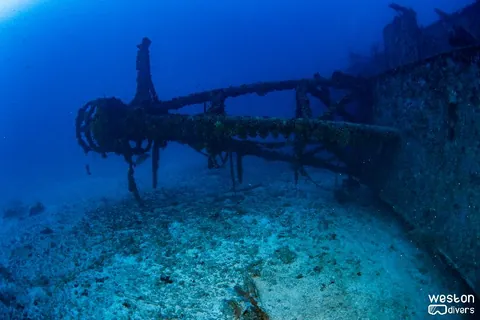
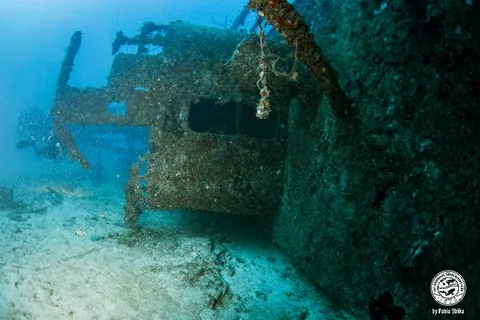
The USCG Bibb, a fascinating wreck off the coast of Key Largo, lies on her side at a depth of 130 feet. While she’s in relatively good condition, diving this site presents several challenges, making it suitable only for advanced divers.
Here’s why the Bibb is considered a demanding dive:
Depth: At 130 feet, it’s beyond the limit for novices and even intermediate divers.
Strong Currents: The site experiences powerful currents, which can make descent along her stern or bow lines feel like being blown by the wind.
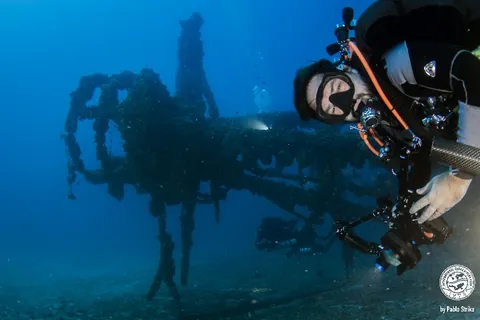
Entanglement Risks: Numerous wires and cables remain on the vessel. Coupled with the strong current, they pose entanglement risks.
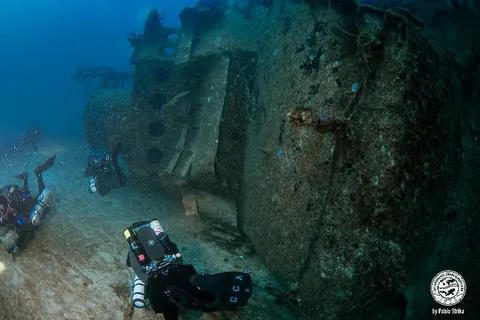
Side Position: The Bibb’s side position further complicates diving into the wreck.
Given these challenges, only experienced divers with adequate certification should attempt dives to the Bibb. Interestingly, an identical sister ship, the USCG Duane, lies nearby and is more accessible due to its upright position.
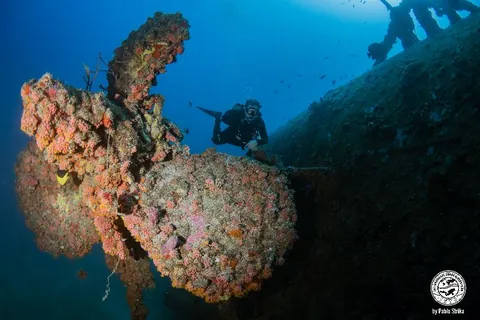
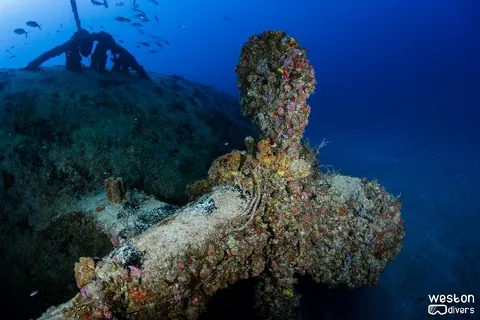
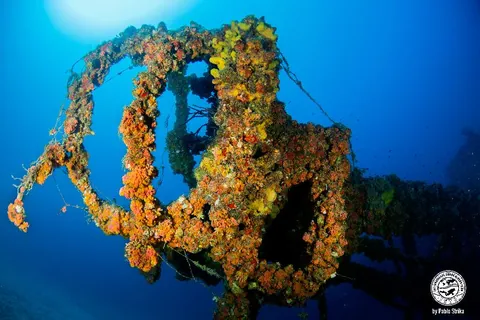
Despite the difficulties, the Bibb’s relative isolation has preserved her condition, and the Florida marine life around her remains vibrant. As you drift dive, you’ll encounter various fish species, and the hull is adorned with coral growth
Route & typical conditions
Route
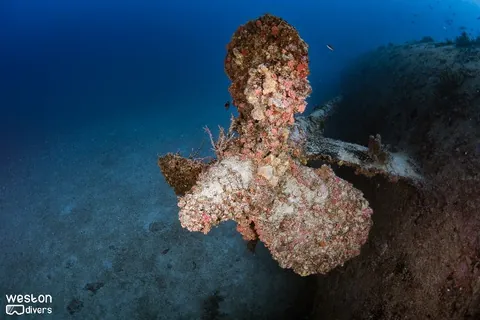
There are two mooring balls in this wreck. Regardless of the ball that the operator chooses, diver will typically get to the wreck and do a couple of laps around the wreck. Because this wreck lies on its starboard, most of the hull is exposed - the portside propeller offers a great picture opportunity.
If qualified and properly trained, penetration is possible in this wreck. She does not offer easy swims through as het sister ship the USCGC.
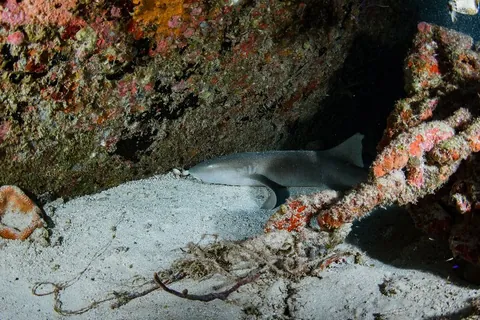
Divers should check on the sand as is common to spot southern sting rays in this site.
The crow nest is another must visit spot - local operators try to keep a Jolly Roger's flag that waves with the current.
Typical conditions
Current are typically strong in this site and may make this site impossible to dive - be ready for operators to call the dive even on a perfect surface conditions due to current.
Visibility is often good, ranging from 50 to 80 feet.
Wreck history
Construction and Early Service:
The Bibb was commissioned in 1937 as part of the United States Coast Guard’s Treasure Class (also known as the Secretary Class).
These steel-hulled cutters were impressive vessels, measuring 327 feet in length with a 41-foot beam.
Capable of cruising at 20 knots, the Bibb carried a crew of 200 and even accommodated a seaplane.
During peacetime, her armament included three 5-inch 51-caliber guns, two quadruple machine gun anti-aircraft batteries, two six-pounders, and ten 3-inch anti-aircraft guns.
Diverse Roles:
As the world edged toward war, the Bibb took on various duties:
A three-month stint with the Navy.
Patrols in the Grand Banks.
Joining a destroyer squadron to protect ships navigating the treacherous Atlantic waters.
Her responsibilities reflected the urgency of the times, and her crew adapted to changing circumstances.
Atlantic Weather Patrol:
In 1940, the Bibb assumed a crucial role—the Atlantic Weather Patrol.
For over a year, she monitored weather conditions, providing vital information for safe navigation.
Her crew braved the elements, ensuring that critical data reached those who depended on it.
Transfer to the Navy:
Under an Executive Order, the Bibb transitioned to the Navy.
Alongside sister ships USCG Duane, USCG Spencer, and USCG Hamilton, she played a pivotal role in safeguarding transatlantic convoys during World War II.
These convoys, laden with merchant ships, faced the constant threat of German U-boats. The Bibb and her crew stood as a bulwark against this menace.
The Tragic SS Henry Mallory Incident:
One of the Bibb’s most poignant moments occurred during the eastbound slow convoy SC-118.
The SS Henry Mallory, carrying American military personnel to Iceland, lagged behind the convoy.
Ignoring the usual zigzag pattern to avoid U-boat detection, the Mallory became vulnerable.
A German U-boat seized the opportunity, torpedoing the vessel.
Chaos ensued as soldiers and crew jumped into the frigid North Atlantic waters. Hypothermia took its toll, and distress signals went unheard.
Fortunately, Bibb crew members spotted a lifeboat from the crippled Mallory, alerting Captain Raney.
Legacy and Exploration:
Today, the Bibb rests on her starboard side at a depth of approximately 130 feet.
Divers, drawn by her rich history and vibrant marine life, explore her coral-encrusted hull.
Bull sharks, great barracuda, and an array of reef fish call this wreck home.
It remains a challenging dive, suitable only for experienced adventurers.