Dive Sites
Browsing as a guest. Create a free account to save trips and plan dives.
+7 photos

Robert Edmister

Wreck · Fort Lauderdale

26° 09.193' N 80° 04.837' W

Open Water Open Water Max 63 ft Avg 72 ft Temporary Line Today AMPoor

Details

Open Water
Minimum recommended certification
Max depth
63 ft
Average depth
72 ft
Access
Temporary Line
Sea state today
AMPoor PMPoor

Video

🎥 Squalo

Pictures 10

Where it is

26° 09.193' N 80° 04.837' W

Next boats to this site 5

Operators that dive here

Best Gas

atm
atm
Overlay Image
Gas prices
Aluminum 80 $10
Steel HP 100 $10
Steel LP 85 $10

Wreck Details

Sunk December 11th, 1989
Cutter
95 ftLength
22 ftBeam

Site description

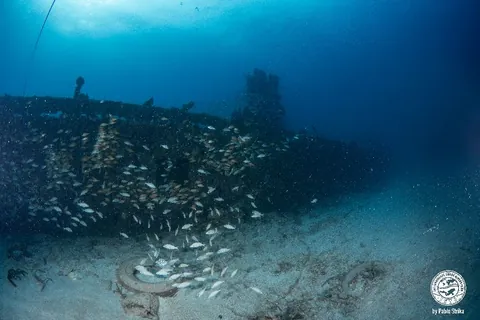
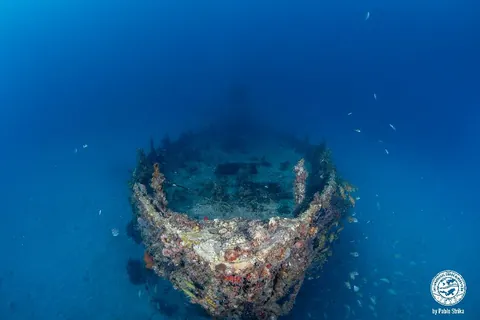
The Robert Edmister was a 95-foot (29-meter) United States Coast Guard cutter built in Maryland in 1953. Originally designated as CG-95304, in 1964, the U.S. Coast Guard began naming their Cape class patrol boats that were under 100 feet (30 meters) in length. Consequently, CG-95304 was renamed Cape Gull. The Cape class cutters featured steel-hulled ships with aluminum superstructures. Among the three sub-classes, class A ships like Cape Gull were specifically designed for anti-submarine warfare. However, in the late 1980s, the Cape class cutters were phased out, replaced by new 110-foot (34-meter) Island class ships. This transition prompted the Coast Guard to decommission many of the earlier cutter designs. Cape Gull was eventually sold at auction to Fort Lauderdale businessman Fedele (Dale) Scutti. He chose to rename her Robert Edmister in honor of a friend, associate, and environmentalist who had passed away. Tragically, on December 11, 1989, the Robert Edmister met its demise when five eight-pound charges were detonated by Broward County’s Bomb and Arson Unit. The wreck of the Robert Edmister now rests upright in 70 feet of water (21.5 meters), approximately 2,000 feet (610 meters) due south of the Jay Scutti wreck—an adjacent artificial reef also facilitated by Dale Scutti in memory of his son. To the south of the Robert Edmister lies the badly broken-up wreck of the Wendy Rossheim, originally a 118-foot (36-meter) motor yacht. The Wendy Rossheim, initially named the Natoya, was constructed at the Defoe Shipbuilding Company in Bay City, Michigan, in 1947. Privately owned by Detroit businessman Harold Ducharme, she sailed extensively around the Great Lakes, operating from her berth in Grosse Pointe, Michigan, until the mid-1960s. After being sold, she resurfaced in Florida. Rumor has it that she spent some time as a United States Navy patrol boat. In the 1980s, she even sailed the Mediterranean under the name Jacqueline 8 before returning to Florida with a new identity: Our House I!!. Tragically, the Wendy Rossheim met a similar fate. She was purchased and intentionally sunk as an artificial reef, renamed Wendy Rossheim after a Fort Lauderdale resident and ocean enthusiast who died suddenly from an infection at the age of 21. On the day after Christmas in 1991, the Wendy Rossheim sank right next to the Robert Edmister, disappearing beneath the surface in less than a minute. To the northeast lies the Paul Sherman, a 56-foot (17-meter) shrimper that had been converted into a salvage boat by a treasure hunter. It is more formally known as the Salvager III.

Route & typical conditions

Route

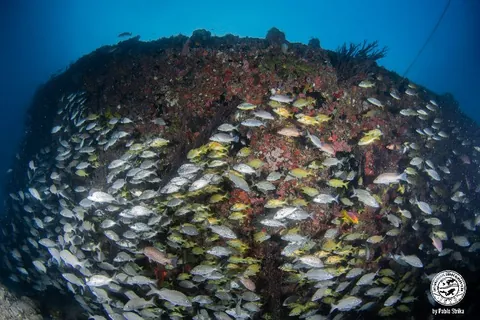
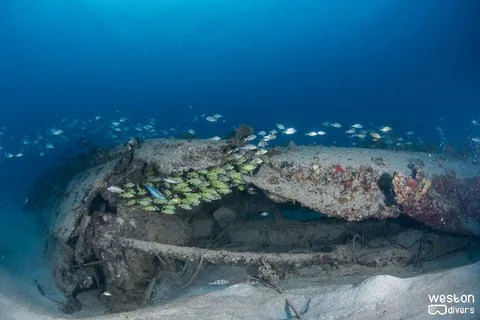
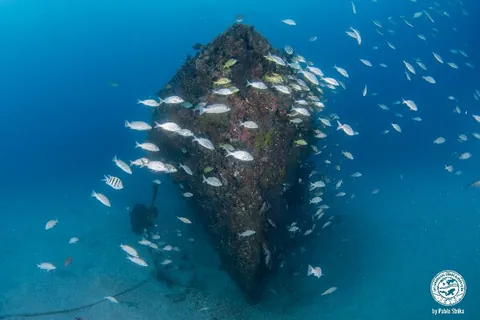
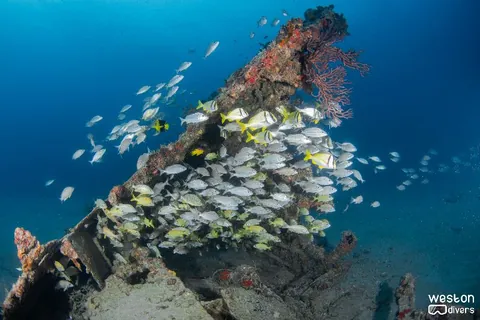
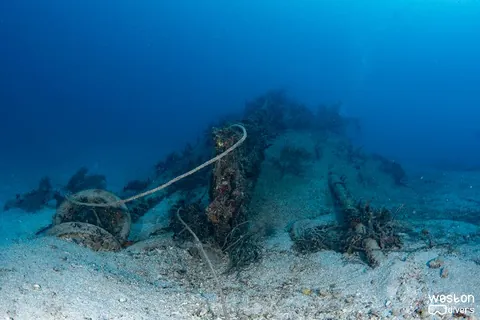
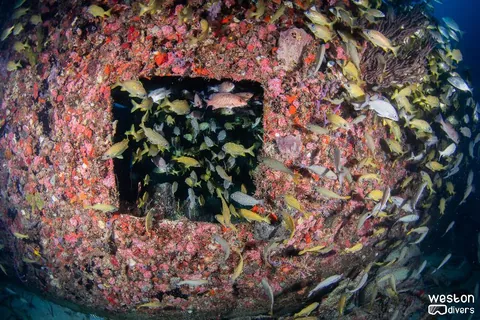
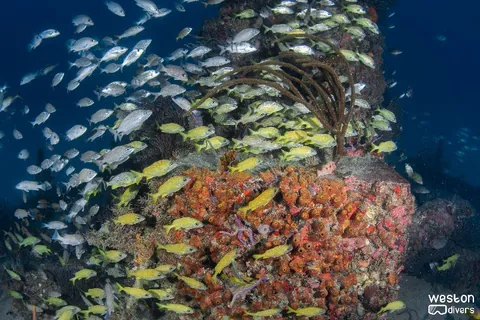
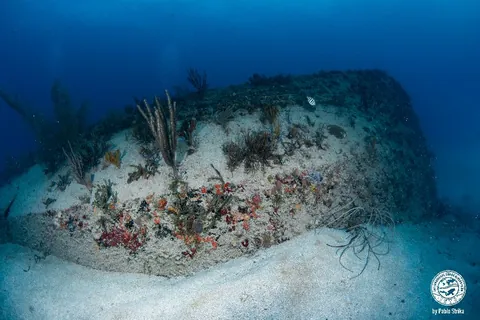
Most dives in this area typically begin and end on the Robert Edmister, which is the most complete of the three wrecks available for exploration. The Robert Edmister’s surface is covered with abundant coral and sponge growth, creating a vibrant underwater landscape. Divers can observe dense schools of snapper and grunts swimming around the wreck. Additionally, it’s essential to keep an eye on the surrounding sandy areas for any stingrays that might be present. A cable extends from the stern of the Robert Edmister to the Wendy Rossheim, located approximately 120 feet (36.5 meters) to the south. This connection allows divers to move easily between the wrecks. The Wendy Rossheim, now resting in several pieces, lies at a depth of around 65 feet (20 meters). Despite severe damage caused by Hurricane Andrew in 1992, the scattered remnants of the wreck continue to attract a diverse array of marine life. Notably, a large goliath grouper frequently moves between the bow and stern sections of the Wendy Rossheim. The third wreck, known as the Paul Sherman, lies approximately 140 feet (43 meters) to the northeast. Unfortunately, due to its inverted position in the water, the Paul Sherman is considered the least interesting of the three wrecks.

Typical conditions

Conditions are typically good in this site - with visibility ranging from 40 to 70 feet. Currents can be strong occasionally. Be mindful if you plan to visit the other two wrecks in this site.

Wreck history

Robert Edmister historic photo
The 95-foot long Cape Class cutter WPB-95304 was built at the Coast Guard shipyard in Curtis Bay, Maryland, and commissioned into the U.S. Coast Guard on June 8, 1953. These Cape Class cutters were primarily a response to escalating Cold War tensions and the need for shallow-draft anti-submarine vessels following World War II. As such, WPB-95304 was equipped with depth-charge racks, mousetrap launchers (rocket-propelled anti-submarine weapons), and standard mounted machine guns. In 1964, WPB-95304 received the name U.S.C.G.C. Cape Gull. During her initial two decades of service, the Cape Gull carried out law enforcement and search-and-rescue duties from her base in New York. After a significant refit in 1977-1978, she was stationed in Miami, where her focus shifted to combating the influx of illegal drugs being smuggled into the country. Following nearly another decade of service, the Cape Gull was decommissioned from the U.S. Coast Guard on May 15, 1988. The obsolete cutter was subsequently sold at auction to Dale Scutti in 1989. Scutti had a poignant purpose for acquiring the vessel: he intended to transform it into an artificial reef in memory of his friend, Fort Lauderdale real estate broker Robert Edmister, who had passed away that year. On December 11, 1989, the Robert Edmister was deliberately scuttled in 70 feet of water off Fort Lauderdale. Over the years, the wreck’s aluminum superstructure has weathered the elements, sustaining significant damage—particularly during Hurricane Andrew in 1992. Despite portions of the wreck collapsing, the Edmister remains an inviting destination for novice divers seeking an underwater adventure. 

Divers' uploaded pictures

No diver pictures yet.

Divers' reviews

Be the first to add a review